The Secondary World

Like Alice through the Looking Glass, three years ago I fell through the screen of my iMac into the brave new world of Second Life. It took awhile to get my bearings. This blog started as a record of my role-playing there, but has mutated into a bit more. Here are my travels across the sims and strange lands of the Secondary World.

Saturday, February 5, 2011

SAIWA

Inside the Station

As humanity finally left behind the confines of its homeworld in the 21st and 22nd centuries, many competing strategies arose concerning how best to deal with the extreme environments of space.   The initial impulse, of course, was to recreate Earth-standard conditions wherever humanity went, but this often proved unfeasible.  Thus came the trans-humanist argument; if not all environments could be adapted to man, perhaps man could be adapted to them.

The Saiwa Facility from Orbit

This was a real crossroads for the human race, as genetic manipulation became possible, raising the question of whether or not it was ethical or even desirable.  As a Time Lord, I am certain that in the Dark Times of our distant past we Gallifreyans were also faced with these issues, but it was all so long ago as to be erased from living memory.  If you have the power to remove frailties and illnesses, to prolong life, to reconfigure the basic design...why not?  

Low-Atmosphere Clones

I considered these things recently as the Fallen Hour and I found ourselves on the Saiwa facility, a genetic nursery that grows tailored clones for low atmosphere environments.  As humanity spread out to colonize the bodies of its solar system, stations such as this one--sponsored by the African Confederation--became quite common.  Largely automated, I wandered the anti-septic halls studying the genetic tailoring process.  And I wondered...how many stations like these did my own ancestors construct as we improved our cardiovascular systems and gave ourselves the gift of regeneration?  If life is about adaptation, where precisely does self-adaptation fit into the scheme?  Lofty questions indeed.

The Early Years of Solar System Colonization


Saturday, January 8, 2011

THE TREES OF NUMBAKULLA

The temple rite is simple
An open heart is first
Water for the living
To quench the living thirst

-"The Temple Rite" (A Numbakulla Poem)

The Withered Trees


I do not, as the Doctor was often wont to do, take up Companions in my travels.  Few species are as long-lived as mine, and any meaningful association with a member of another race is doomed to be fleeting.  For them, life passes so quickly, and as they age and weaken, I go on year after year regenerating.  It is not fair, I think, to make them watch this, to have them realize how limited their own time is while mine seems to run on and on.  And for my part...I have already lost everything; my race, my home.  I do not want to add new Companions to the long catalogue of what time has taken from me.

Nor do I find members of what my people patronizingly called "the Lesser Species" to be half as interesting as the Doctor did.  Perhaps because they are so short-lived, their lives seem to be spent in willful ignorance, grasping at all they can get and consume "now" with little thought towards the consequences.  Most seem to me predictable and dull.  Most, but not all.

While tangling with the Order of Malkuth in the streets of New Babbage, I found myself allied with a remarkable Terran woman named Dinah Greymoon.  A young adventuress with a knack for racing and consequently destroying vehicles, when I first came across her she was recovering from a crash that had tipped her into one of New Babbage's wintery canals.  Together we encountered a street urchin who had valuable information, and after warm cups of chocolate in a cafe, the hunt was on.  I found her to be spirited and full of what the Earth people call "pluck."  It surprised even myself then when I invited her aboard The Fallen Hour for a few short voyages.  After a Black Hole and a missing moon, I showed her a reflection of lost, time-locked Gallifrey.  Though slightly overwhelmed, she took all in stride.

When we parted in New Babbage, I did not think to see her again.  But I had given her a means to contact me and she did so...finding herself shipwrecked on an abandoned isle while sailing for Tahiti.  The sole survivor, she had come across the ruins of a strange civilization, and sent for me.  I came almost immediately.

**ALERT: RIVER SONG SAYS "SPOLIERS!!!"  IF YOU INTENDED TO PLAY THE "POT HEALER ADVENTURE" LOOK UP NUMBAKULLA AND GO START.  READ NO FURTHER UNTIL YOU DO!!!** 

On this island, Numbakulla, a tragic tale played out of over-reaching human ambition.  As the mystery unfolded, it appeared that what had once been a unified and peaceful society split into two factions, and ended up destroying itself in the process.  Concerned with guardianship of the two sacred trees housed in  a massive temple atop the island's highest mountain, the people of Numbakulla became divided into the "Gardeners" and the "Pot Makers."  In time their differences separated them, and they built very different civilizations on opposite ends of the isle.  As the Pot Makers delved deeper and deeper into new technologies, they lost sight of their sacred duties and caused the great trees to wither.  Life on Numbakulla languished and died.  But led by ancient clues and the notes of another, earlier shipwreck victim, new seeds were discovered hidden, and a chance for Numbakulla to be reborn.

The Great Temple

In the wake of the mystery, Miss Greymoon and I parted company again.  But I have come to understand, a little, what the Doctor saw in his Companions.  If they possessed any of the wit, perception, and strong will of Miss Greymoon, it is easy to see why he so often enlisted their aid.

The Gardener Civilization was Organic in its Technology


The Pot Makers Evolved Along More Conventional--and Ambitious--Lines


Sunday, January 2, 2011

Looking Ahead to Series 6

I will be the first to admit I wasn't wild about Series 5 when it first began.

I think, honestly, my taste buds had been desensitized.  After all, Russel T. Davies' Doctor Who had been like huge, spicy helpings of Thai green curry...hot, fiery, and anything but subtle.  His Doctor was an operatic figure,  a tragic hero.  Moffat is a very different kind of writer.  He is subtle, and his Doctor is a return towards the classic program, the erratic alien who meddles in lives like a trickster or clown.  Having been overwhelmed for four years, Series 5 came off as a whimper rather than a bang.  Which of course is not really fair after going back and giving it a second viewing.

I should point out that of all the writers who worked under Davies, Moffat was my favorite and I was initially thrilled to hear he was taking over Who.  "The Empty Child/Doctor Dances," "The Girl in the Fireplace," "Blink," and "Silence in the Library/Forest of the Dead" are among the best episodes the Davies' years had to offer.  His episodes also introduced two of the most intriguing characters Whodom has ever seen; the roguish Captain Jack and perplexing River Song.  And if Davies excelled at emotional highs and lows, Moffat's gift is that he understands better than anyone else in Doctor Who history that the show is essentially about "time travel," and how to use that in the plot.  In "The Girl in the Fireplace" he wielded it as an emotional weapon.  In "Blink," he boggled the audience's mind with the DVD sequence.  And don't get me started on the ingenious out of sequence relationship between River and the Doctor.  Looking back then, my initial distaste stemmed from the fact that I had unconsciously expected him to continue the tone and feel of the Davies era, something I was wrong to expect.

I was also mistakenly disappointed with the finale of Series 5.  Who the heck made the TARDIS blow up?  What brought that impossible alliance of hostile aliens together?  What is the bloody Silence?  And will somebody please explain to me why "The Lodger" just got brushed under the rug?  I mean, someone was trying to build a freaking TARDIS!!!!   But seeing the Series 6 trailer, I understand that Moffat plans to answer all those questions, but unlike Davies, who wrapped up his story arcs in a single season, Moffat has spread his out over two (or three?).  

And I, for one, and really looking forward to it.  


Tuesday, December 28, 2010

The Novatech "Smith" TARDIS

For Second Life Doctor Who enthusiasts, there are a number of TARDIS time capsule purveyors across the Grid.  Three of the major players are Hands of Omega, Novatech, and New London Systems.  This year, with the arrival of a new series--and a new TARDIS interior--all three outfits have been working on their own versions of the Matt Smith console room.   New London got theirs out first, and erected a much higher prim "demo" version.  Hands of Omega is said to come out with theirs in the spring.  And just in time for Christmas, Novatech released theirs with a genuine demo model at their space station headquarters.  At a price tag of $2400 Lindens, I didn't even blink before snatching it up.

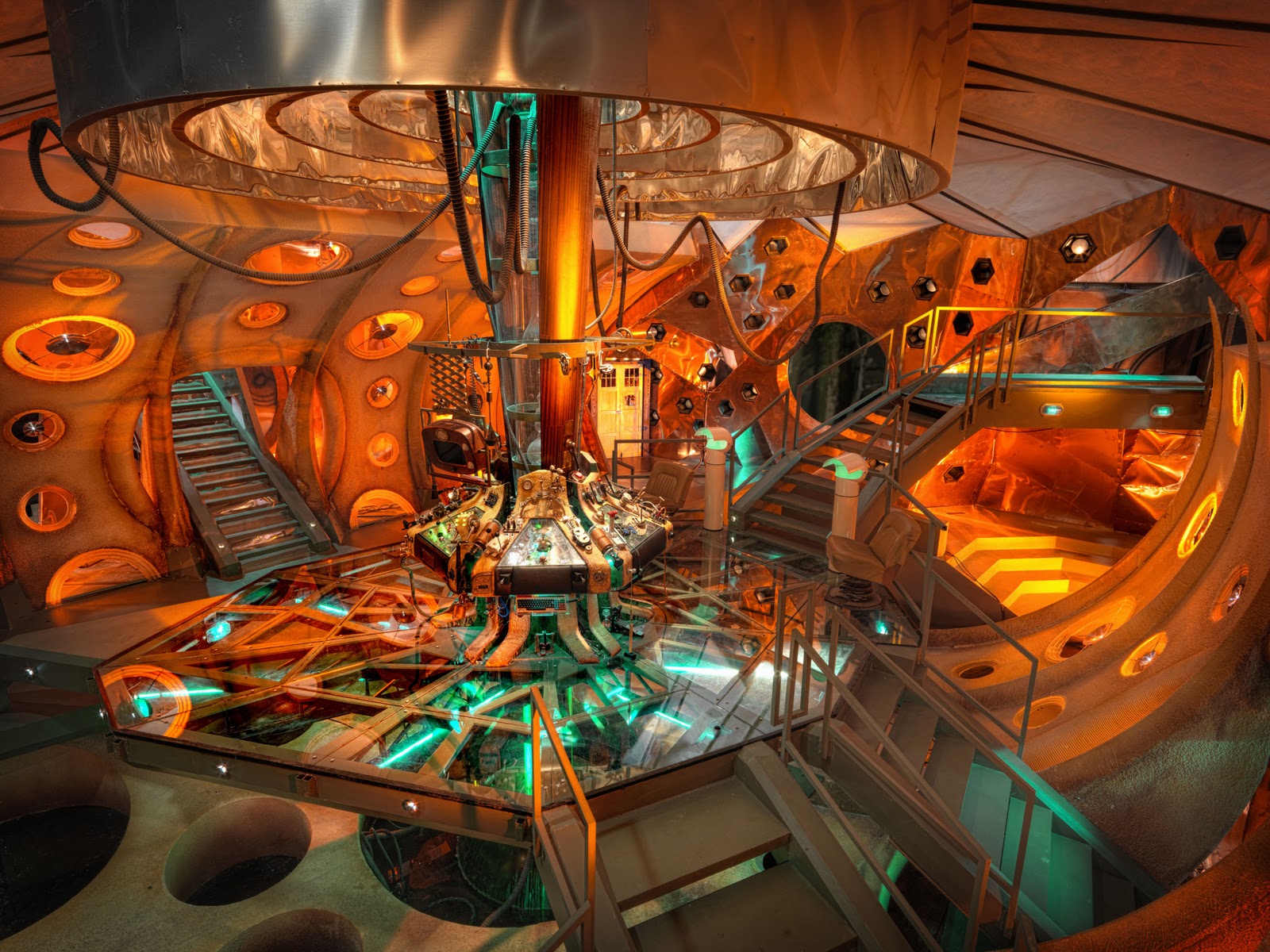
I have been eager to see what people make of the Matt Smith TARDIS, one of the most stunning and ambitious sets the BBC has ever produced for the long-running drama.  One of the key challenges, of course, was prims.  For non-residents, a "prim" is the basic building block of any object in the digital world of Second Life.  Made up of polygons, prims can be modeled into just about anything using the object editor.  As a general rule of thumb, the more ornate and detailed an object, the more prims it must be built of.  Low-prim objects tend to look lumpy and cartoonish.  With the massive complexity of the Smith TARDIS (see below), it was clear that any Second Life version was going to be a prim-heavy monster.  This matters because when people rent land in Second Life, they have a prim limit, a maximum number of objects they can "rez" or open on their property.  To reach the greatest number of customers, designers need to strike a balance between less prims and detail.

The Matt Smith 2010 TARDIS Interior

The Much Simpler 1985 "Classic" Interior

Weighing in at 736 prims, the Novatech Smith Console is not exactly "small," but it does a very good job of capturing the detail and size of the Series 5 set without being impossible to rez.  My parcel of land has a limit of 937 prims, but it is the unique quality of Novatech's "rezzing" system that makes it easy for me to own.

The Smith Console Room From An Angle Similar To The Shot Above

Basically, it works like this:  Hand of Omega console rooms are essentially "skyboxes," permanent structures that you rez in the skies over your parcel.  The doorway of each is a portal system.  Inside your skybox, you set the coordinates on your console, the TARDIS "travels" awhile, and then you exit through the portal.  It teleports you whatever location in the Grid you programmed, and a TARDIS exterior materializes around you.  Thus the illusion is created that the TARDIS is A) bigger on the inside, and B) has travelled in Time and Space.


The Novatech console traditionally works along the opposite lines.  The TARDIS exterior--be it a Police Box or whatever--is itself a vehicle.  You can climb in and pilot it, flying around.  You can also teleport around the grid.  Inside the vehicle you can store various console rooms, corridors, and additional chambers.  By parking the TARDIS, you simply touch the craft and receive a menu from which you select what room you want to rez.  In other words, the Hands of Omega versions are skyboxes that rez capsules, while the Novatech models are capsules that rez skyboxes.


I mention all of this because the Smith Console does both.  Like any Novatech TARDIS, the capsule is a small vehicle that flies and teleports around the Grid, rezzing console rooms and additional chambers around it when needed.  But it also includes a portal doorway, activated at the console. This doorway is part of a vast network compatible with all Novatech portal systems.  To my mind, this is the greatest advantage of Novatech Time Capsules.  While both Hands of Omega and New London Systems just do TARDISes and Doctor Who related products, Novatech has a vast line of products that are all compatible with each other.  They have Star Trek rooms, teleport systems reminiscent of Stargate, the Star Trek transporters, and even the Harry Potter flue powder network.  Because of this, a wider number of people use Novatech goods and you can access any of them with the Smith portal, giving you hundreds of locations programmed right into your TARDIS console to teleport to and explore.

A Closer-Look At the Incredibly Detailed Console

If this wasn't enough, the Smith TARDIS console also produces and provides its owner with sonic screwdriver sets (including old and new versions, as well as the Master's "laser" screwdriver).  These devices can't actually open all locks in the Grid, but the do allow you to pass through the wall or doorway in front of you, creating the same effect.

The Portal System Door (on the left) Lets You Travel All Over the Grid, While the Monitor (the Large Circle to the Right) Allows You to View Pictures or Watch Streaming Media 

As both an emDash (a personal teleporter device that does about fifty amazing things, including rezzing scenes and objects around you) and Horizons (a "holodeck system," or rezzer that allows you to build and store complex buildings, objects, and scene and rez them when desired), Novatech's Time Capsules are for me ideal.  All the technology is compatible, which between my TARDIS, emDash, and Horizons system allows me to have a massive TARDIS with a dozen console rooms, libraries, swimming pools, bedrooms, corridors, etc all on just 937 prims of space.  The Smith Console is, to my mind, one of Novatech's finest achievements, really creating the illusion of being a Timelord with all Time and Space at your disposal.


Tuesday, December 21, 2010

Seen Around the Metaverse...

CIA Data Extract: Psi-Theta 7111-23somue
Subject: Daemiiandraegonneandroluvar
Aliases:  Damien Draegonne, Lord Draegonne, Deimiyanu-sensei
Re: Metaverse Sightings, Time Band 10 December to 22 December 2010 Local Time


Begin Image Display:


Subject Active In New Babbage City, Perhaps Engaged In Study of Local Defence Grid


TT Capsule Detected In Vicinity of World Trade Center, Terra, New York, Prior To Their September 11 2001 Destruction.  Image A


Image B


Image C

TT Capsule Detected in Deshima Nebula On Approach To Deshima Station


Arriving Deshima Station


Recovered From Primitive Digital Imaging Device, Elfhame Islands; Notice TT Capsule In Background


Terran Moon Base, Circa 2021 AD

Monday, December 6, 2010

THE BLACK HEART, PART TWO

Professor River Song says "SPOLIERS."  Though I will refrain from saying how to solve the puzzles, I will be talking a bit about the tale they reveal.  Please PLAY the game first.  I warned you.

On the Case in New Babbage

I spent the evening (New Babbage time) back aboard The Fallen Hour, turning the document over and over again in my mind.  I determined that it must be some sort of code, and not knowing enough of the local alchemical lingo, realized I would have to go back out into the city to get it.  After combing the streets of New Babbage, I found what I needed and set to work on translating the papers.

It was a curious tale.  The author claims to have discovered that ultimate alchemical secret, the creation of life.  Apparently he was successful in breeding a "homonuculus," a creature that went wrong and may have been responsible for several grisly murders.  He mentions a box containing more of his secrets (I too know what it is like to be a man with a box of secrets), but the box I found beside the scroll was empty.  Has someone else seized them to continue his work?

A homonuculus.  Honestly, you would think the humans would learn to leave meddling in the secrets of the universe to their betters!  Is it possible that this creature was inside the statue?  Can they live indefinitely?  And will it kill again...

Anarchists in New Babbage


The stakes may just have been raised.